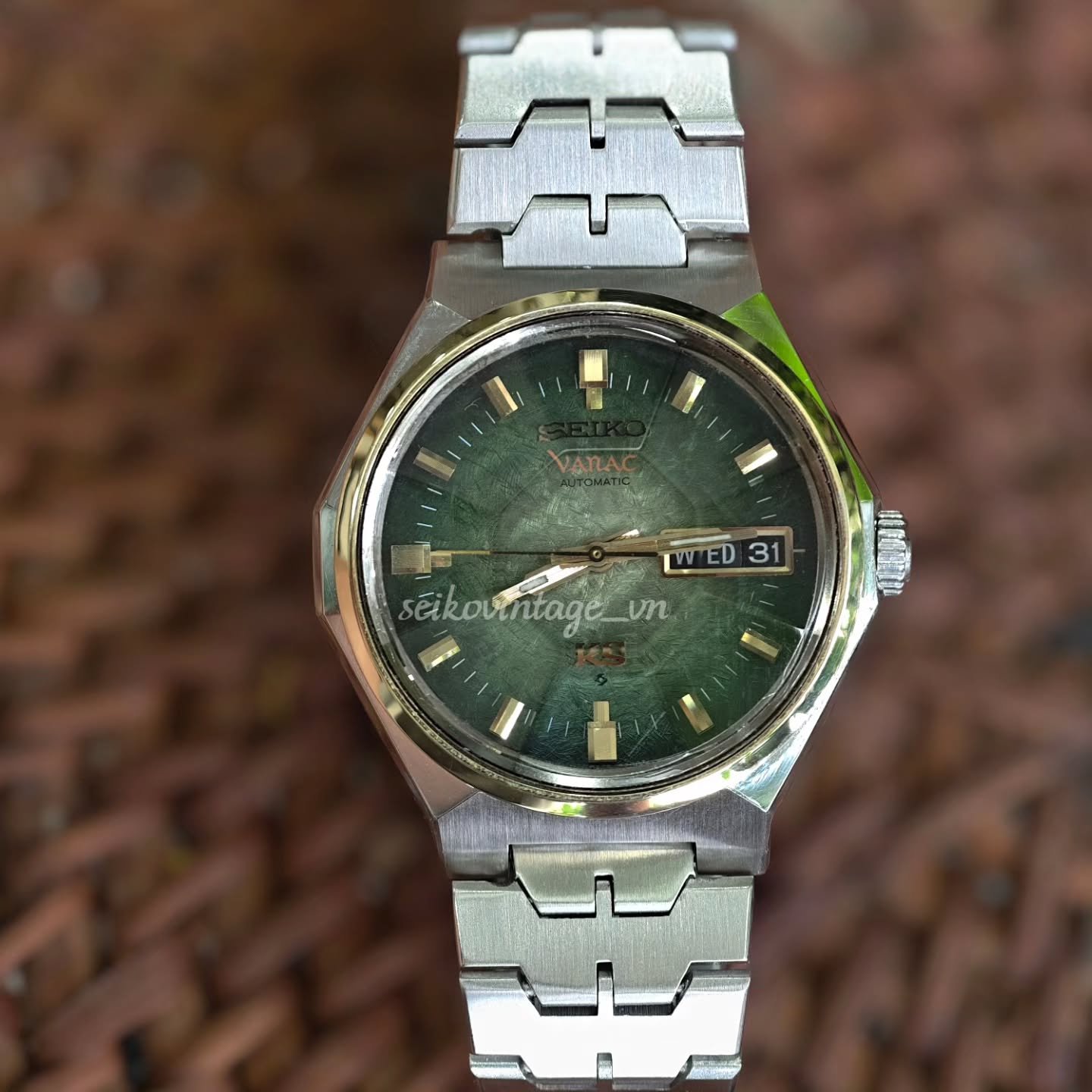
Step-by-Step Buying Inspection Guide
Follow these four steps to vet any vintage King Seiko listing on forums, auction sites, or dealer platforms.
1. Inspect Case Geometry for “Grammar of Design” Lines
Taro Tanaka established strict design rules for Seiko in 1962: flat surfaces, sharp angles, and zero visual distortion along mirror-polished planes.
Check the transitional ridge separating the brushed top surface of the lugs from the mirror-finished flank.
Look at the lug tips. Factory lugs end in flat, distinct vertical planes. If the tip tapers off like a smooth river stone, the case has seen a buffing wheel and lost its collectible value.
Pro-Tip: Ask the seller for side-profile photos under directional lighting. Reflections along the case flanks should be sharp and straight. Wavy or warped reflections indicate over-polishing.
2. Detect Redialed and Refinished Dials
Original King Seiko dials feature sharp, silver sunburst brushing radiating from the center pinion.
Dial Code: Look at the bottom edge flanking the 6 o’clock position. Every factory dial has microscopic text matching the case reference (e.g., JAPAN 45-7000T or JAPAN 5625-7000T). Absence of this line means an aftermarket redial.
Logo Alignment: The applied “SEIKO” and printed “KING SEIKO” scripts must have razor-straight kerning. The Daini lightning-bolt logo printed above 6 o’clock should show crisp internal corners without blotchy ink bleed.
Indices: Markers are diamond-cut with micro-grooves. If the hour markers look dull, uneven, or painted over, reject the watch.
3. Verify the Gold Caseback Medallion
Pre-1972 models feature a gold-alloy medallion inlaid into the caseback recess (bearing the KS shield or the Seiko wordmark).
Examine the perimeter of the medallion cavity. Sweat and moisture often gather here, resulting in dark pitting or galvanic corrosion between the gold medallion and the steel caseback.
Many vintage models have missing or cracked medallions. While aftermarket replacement medallions exist on eBay, an intact, original factory medallion with clear matte-textured background letters adds $150–$300 to the value.
4. Test the Crown and Quickset Functionality
Pull the crown out to the setting positions:
Position 0 (Pushed in): Manual winding should feel consistent without gritty resistance.
Position 1 (First click): For day/date calibers (4402, 4502, 5626, 5246), rotate the crown to change the calendar wheels. The date should click instantly.
Position 2 (Second click): Rotate the hands past midnight to confirm the calendar flips smoothly. Check that the hacking lever halts the seconds hand dead on the mark.
Common Mechanical Pitfalls & Solutions
Issue 1: The Broken 56xx Quickset Date Rocker
The automatic 56KS series (Calibers 5621, 5625, 5626) is the most common entry point into vintage King Seiko, but it contains a notorious factory flaw: a dual-material date-corrector rocker with a tiny plastic star gear mounted on a metal arm. If a previous owner attempted to change the date while the watch was between 9:00 PM and 4:00 AM, the calendar drive teeth shattered this plastic gear.
The Symptom: Turning the crown in position 1 spins freely with zero movement from the date or day wheel.
The Fix: Do not hunt down “New Old Stock” (NOS) factory parts; NOS plastic will have turned brittle with age and will fail quickly. Purchase a modern CNC-machined brass or aluminum replacement rocker (commonly produced by vintage Seiko specialists on eBay and forums for $30–$45) and have a watchmaker install it during service.
Issue 2: Weak Click Springs on 45KS Hi-Beat Mainsprings
The manual-wind 4500 and 4502 calibers beat at 10 ticks per second (36,000 bph). To drive this high-frequency escapement, the movement uses a stiff mainspring. Over decades, winding to full tension can shear the mainspring or wear out the click spring holding tension on the barrel arbor.
The Symptom: The crown slips backward immediately when released during winding, or winds indefinitely without tension.
The Fix: Independent watchmakers can substitute compatible modern mainsprings or harvest components from common donor calibers (such as the base Lord Marvel 5740C or manual King Seiko calibers). Verify with the seller that the watch runs at the full 36,000 bph rate on a timegrapher.
Issue 3: Pitted Monobloc Case Openings
Certain 56KS references (such as the 5626-7000) use a “monobloc” or one-piece case without a traditional screw-off caseback. The movement decases exclusively through the front crystal bezel.
The Symptom: Moisture enters past hardened crystal gaskets, rusting the case dial seat and the micro-regulator screw hidden between the lower lugs.
The Fix: Ensure the external regulator adjustment screw (located at the 6 o’clock case flank between the lugs) turns without binding. If stripped or rusted shut, timing adjustments require complete dismounting of the crystal.
Frequently Asked Questions
What is the core difference between vintage Grand Seiko and King Seiko?
Grand Seiko was produced primarily by the Suwa Seikosha facility, while King Seiko was developed by the rival Daini Seikosha plant as part of Seiko’s internal competition to drive mechanical innovation. Grand Seiko occupied the absolute top tier in catalog pricing, but both lines shared identical chronometer-grade testing standards and the same exterior case finishing protocols under the Grammar of Design guidelines.
Which vintage King Seiko reference is the best entry point for a first-time buyer?
The 5625-7000 or 5626-7000 offers the most balanced starting point. These automatic references feature strong, angular Grammar of Design cases, 28,800 bph movements, and widely available donor components. Working examples typically sell between $400 and $750 depending on condition.
Can I wear a vintage King Seiko in water?
No. Even if the caseback reads “WATER PROOF” or “WATER RESISTANT,” vintage gaskets in the crown stem, crystal seat, and caseback channel have dried out over the past 50 years. Keep vintage King Seiko watches away from hand-washing splashes, showers, and heavy rain.
How much does a routine service cost for a vintage King Seiko in the US?
A standard tear-down, ultrasonic clean, relubrication, and regulation by an independent US watchmaker specializing in vintage Japanese watches costs between $180 and $350 for non-chronograph calibers (44xx, 45xx, 56xx). Sourcing replacement parts (such as new crystals or metal date rockers) adds $40 to $100 to the final bill.